

Let’s get one thing straight: most service delivery operations didn’t break — they scaled into chaos. And that chaos wasn’t caused by bad intent. It was caused by saying “yes.”
Yes to client-specific workflows. Yes to legacy tools. Yes to “just this once” exceptions that became the rule.
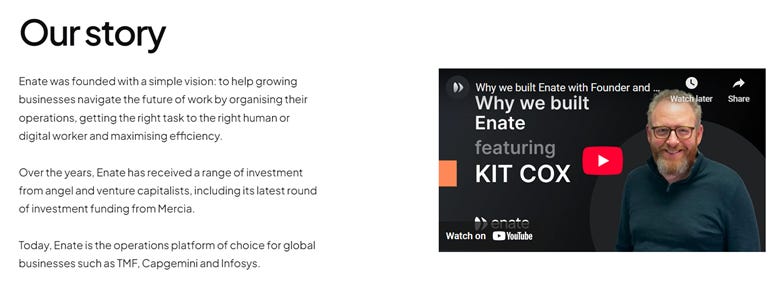
I sat down with Kit Cox, CEO of Enate, for the final episode of this podcast series — and we went deep on what it really takes to deliver exceptional B2B services in 2025 using AI.
Spoiler: it’s not more bots.
It’s orchestration.
1. What’s Changed in 10 Years? Honestly… Not Much.
Sure, the tech has evolved. But customer behavior? Still the same.
Email still dominates. Spreadsheets still live. Clients still expect hyper-personalized service — even if they won’t use your self-service portal.
So what happens? You say yes. You grow. You scale. And now you’ve got 500 clients, each with a slightly different flavor of “how we do things.”
Kit calls it the chaos of success. And he’s right. Because at scale, variance kills.
2. Email Is Still King — But Now It’s Smart
Everyone loves to talk about chatbots and agents. But if you’re running a service operation, you know where the real battle starts: the inbox.

Kit breaks it down simply:
Step 1: Figure out what the hell the email is about (categorization).
Step 2: Route it fast, based on SLA, skill, and service intent.
Step 3: Extract real-time sentiment, not for NPS vanity, but for revenue insight and churn prediction.
And here’s the kicker: absolute sentiment is useless. What matters is trend. Is your client happier this week than last? That’s the gold.
3. The Middle Layer is the Messiest — and Most Underserved
You’ve categorized. You’ve tagged. You’ve routed.
Now comes the hard part: realizing you don’t have the data you need to deliver the service.
Sound familiar?
That’s where the new frontier is forming — agentic AI and contextual automation. The messy middle of service delivery, where:
Data is missing or wrong
Multiple systems contradict each other
Customers ask vague questions with half the inputs
This isn’t about “just do it” automation. This is about handling nuance, ambiguity, and information fragmentation — at scale.
4. Intelligent Document Processing Finally Grew Up
OCR is old news. But pair it with LLMs, and suddenly IDP (Intelligent Document Processing) becomes a superpower.
We’ve now reached the point where you can throw a scanned, handwritten insurance form at the system and say:
“Give me the policy number, the beneficiary, and the termination date.”
Boom. Done.

Templates? Dead. Handwriting? No longer a blocker. But here’s the important bit: exception handling still matters. The magic is in shifting humans from the front to the back of the process — volume handled by AI, edge cases handled by people.
5. The Real AI Strategy for 99% of Companies
Let’s stop pretending every company needs a custom AI model.
You don’t need an LLM engineer. You need productized AI that’s ready to plug into your business today.
Kit nailed it: “Your wife’s gardening app is more of an AI strategy than most companies have.”
The point? Use what exists.

Don’t reinvent it. Orchestration — not invention — is the power play.
6. Owning the Output: AI Governance Is Your Job Now
Here’s a non-negotiable truth: if AI writes your emails, those words are yours.
The tone, the values, the response — it all reflects on you. So if you’re using third-party models, you better understand their training data and alignment structure.

Smart AI buyers don’t just ask “what can it do?” They ask: “What does it say about us?”
7. Enate’s DNA = Orchestration, Not Automation
Enate isn’t selling another AI widget. It’s selling harmony.
The core idea: you’ve got categorization AI, IDP, human experts, agents, LLMs, APIs — and they all need to play nice together.
Orchestration is what makes that possible. And without it, you’re just optimizing chaos.
Kit’s 3-step formula is dead simple:
Operationalize – Get visibility and control.
Optimize – Use the data to fix the stupid.
Automate – Only where it makes sense.
Forget “automate everything.” Automate what’s proven. What’s painful. What’s measurable?
Final Word
Most companies don’t have a service delivery problem. They have a fragmentation problem.
Too many systems. Too many processes. Too many “just this once” decisions. The fix isn’t more AI. It’s orchestration.
That’s how you move from chaos to control — from duct-tape delivery to scalable excellence.
Want to learn more? Go to enate.io. And watch the full conversation with Kit — our final episode in this series.
Let’s stop firefighting. Let’s start orchestrating.
— OG
Real talk. Smart tech. OG approved. Subscribe now: https://www.youtube.com/@olivier_OG
OG insights, straight to your inbox. Subscribe here:

AI, automation, impact. I break it down. Follow me: https://x.com/Olivier__OG


